
You are currently browsing Jessica’s articles.
 I’ve never been one for “studying” literature. Dissecting plot lines, themes and social context doesn’t really inspire me. That is the main reason why I never pursued a degree in English Literature, despite my passion for reading it. I didn’t want to make it work.
My senior year in high school AP English is a perfect illustration. We studied a lot of works that year (1984, Canterbury Tales, and Macbeth to name a few). The total number of pages I read can be calculated easily – zero. How did I pass? My class was filled with the smartest of the smart kids that year (one major exception being my friend Christine who, I suspect for communist reasons, opted out of AP for regular English class *gasp*) and all I had to do was let them start the discussion and take their talking points a bit further down the road.
I’ve never been haunted by the ghosts of AP English past, and I’ve never taken the time to read the books I should have read ten years ago. In fact, I always felt as if I had already read Pride and Prejudice. It’s such a famous book that it’s wormed its way, Jungian style, into the literary and popular culture (see it referenced in the movie You’ve Got Mail). Between the BBC version, the new Keira Knightly movie and the pervasive Bridget Jones I’m sure everyone feels it would be a bother to actually open the pages. We already know the story.

There are a ridiculous number of books on dog training and in my neurotic quest to get it right with my puppy, I’ve read most of them, to my own detriment. There are dog listeners, dog whisperers and dog channelers; all of them claim to know the one right way to train your dog. There are those who sit on their dogs, those who blitz them with “leadership signals” (whatever these are), those who believe you shouldn’t greet your dog when you get home, and those who think you should eat a cracker before serving your dog its food, just to show him whose boss. Consequently, my head is brimming with conflicting facts and theories, ideology and philosophy. It’s giving me a migraine.
The major fare that each of these authors (I’ll purposefully leave them unnamed, though you know who they are) is selling is that they have the GOSPEL – the holy word of dog. In order that to find nirvana with your canine friend (to mix religious metaphors) you have to follow their way and no other.

Sometimes in a split-second, implusive decision you can pick up a book that is exactly what you are supposed to be reading at the very moment in your life. Sometimes you find a book that you are ready to listen to, even though you wouldn’t normally be open to what it has to say to you. You don’t, as usual, ignore the importance of the messages it contains. You find the book just when you can use it most.
For me, now is that sometime.
Families are something we all struggle with, not matter how “good” or “bad” our upbringing and current situation. There are conflicts and tensions so tightly interwoven with our psyches that some never know what are their own ideas and what is their reaciton to their family. Creating our own families is likely the only thing scarier than dealing with the ones we already have. Particularly if we feel insufficiently prepared, as most of us do.
Delving into these issues, this book addresses the question what is family? And not surprisingly it does not give any answers.

The ability of children’s literature to handle the “hard topics” is often underestimated. Sometimes authors are criticised for pandering to children; they are accused of telling kids that the world is a good place where the bad guy always loses. Embarrassingly my return to YA fiction in my adulthood was for this very reason. Mostly it has been about nostalgic memories and a yearning for simpler stories. As I creep farther and farther in adult society, children’s stories address a need for clear cut lines and black and white outcomes.
If only it were that simple. That I am misremembering is becoming increasingly clear. Books like Bridge to Terabithia, Where the Red Fern Grows, Charlotte’s Web, and Tuck Everlasting are simple? Clearly not. They delve deeply into the basic questions of life: death, love, family and loss. I’m finding that most YA fiction written today follows the example of these classics. In fact these days authors more often come under heavy fire for treating kids as they should – as intelligent beings able to deal with complex issues.
 Sometimes, while reading a good book I hear a buzzing, needling little voice floating around in the back of the mind. Every time I try to capture it, it quickly dissolves away. But it’s persistent and it generally ruins what would otherwise be a great reading experience.
I’ve spent the past two days completely riveted by this poignant and vivid story of a young Jewish girl and her brother. Newly christened Hansel and Gretel, they are abandoned by their stepmother and father in the woods of Poland. Their journey toward survival is so heartbreaking and so real that I found myself wrapped in a blanket in my warm armchair, still shivering along with these two cold children hidden under leaves and snow.
Just in case any of you were wondering if I had crushes on female authors. . .
****
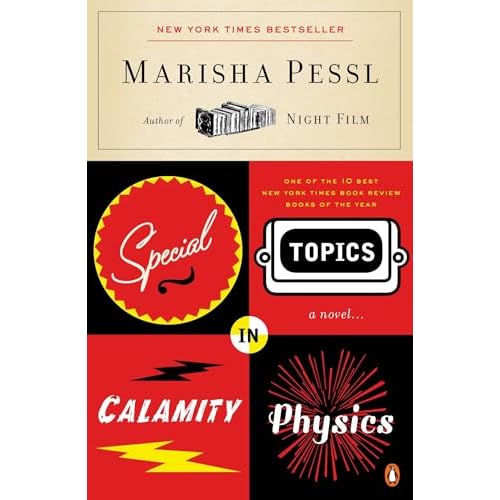
My science training tends to color my thought processes in strange and funny ways. Science is all about theories and the “facts” to support them (See Roberts Hooke and Boyle 1650-1703). It oftentimes seems to be at odds with my love of fiction, which requires a conscious suspension of disbelief (see also dramatic convention). Somehow though, my brain has learned to reconcile the two (see right vs. left brained funderstanding.com, 2007).
I love a well formatted document (Publication Manual, APA 2001) or a heavy tome about something interesting (see Selfish Gene, Dawkins, 2004). I also love an unabashed classic of literature (see Penguin Classics) but when a great novel comes along that tickles that sciency part of my brain, it’s a uniquely pleasurable experience (October, 2001).

As I was emptying my bag from a recent trip to the library, my boyfriend Tim looked at the stack which included Arabat and its sequel. “Who’s Clive Barker?” he asked, “And why do you have all his books?” I smiled a shy smile. I know I’m doing it again.
I develop crushes on authors the same way I used to crush on boys in junior high (OK, and in high school and a little bit in college. . .). Here’s a snippet from my diary: I love Chad. I love Bryan. I love Kevin. I love Kevin and Bryan and Chad. *Sigh* Riveting prose, I know. Apparently I never grew out of this phase, I merely redirected it.
 I must be getting old.
I don’t usually identify with the mothers in the books that I read. One reason is obvious — I’m not a mother. But I think it goes deeper than that. My friend Scotty used to say How can we have kids when we can barely take care of ourselves? Amen. Part of me still feels unprepared for life and so the thought of being responsible for another life is very scary to me.
However I do plan on being a parent one day. And I recently got a baby dog rather than an adult dog in complete moronic confidence in my nascent parenting skills. I reminded myself that I have raised two cats properly. It was going along fine until it became clear that this pup needed special support and guidance. My worst fears began coming true: I had taken the responsibility for another life, and I was screwing it up.
I worried incessantly, as is my habit. In my daily reading of Al Capone, I began to realize how much I was becoming like Moose Flannagan’s mother in her dealings with Nathalie, her autistic child. Mrs. Flannagan’s faith hung on the word of experts; she used every tactic they gave her with the hopeful optimism that this would be the one (For my part, I talked to two dog trainers and a breeder and read three books). I felt her disappointment that with every small step forward were precarious steps backward. The day I picked up the business card of an animal communicator I knew I had reached my lowest point, which fortunately for me falls far shy of Mrs. Flannagan’s deluded attempt to pass her 16 year old daughter off as a ten year old.
As I identified all over the place with this strong yet brittle woman, I began to realize that no one is prepared for parenting and raising a child (whether a two footed or four footed version). And that all my obsessive preparations will not be any help.
Which leads me to the uncomfortable conclusion that I have to learn from Mrs. Flannagan’s experience. I need to take a deep breath. And learn to trust myself.
Yikes.
 What We're Reading Now